

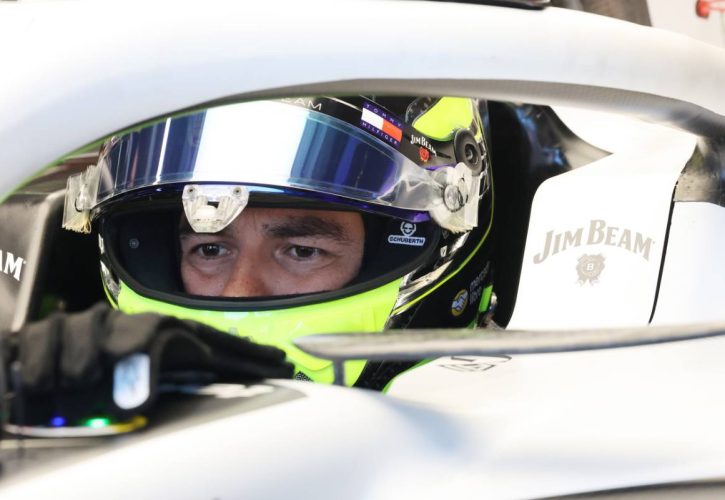


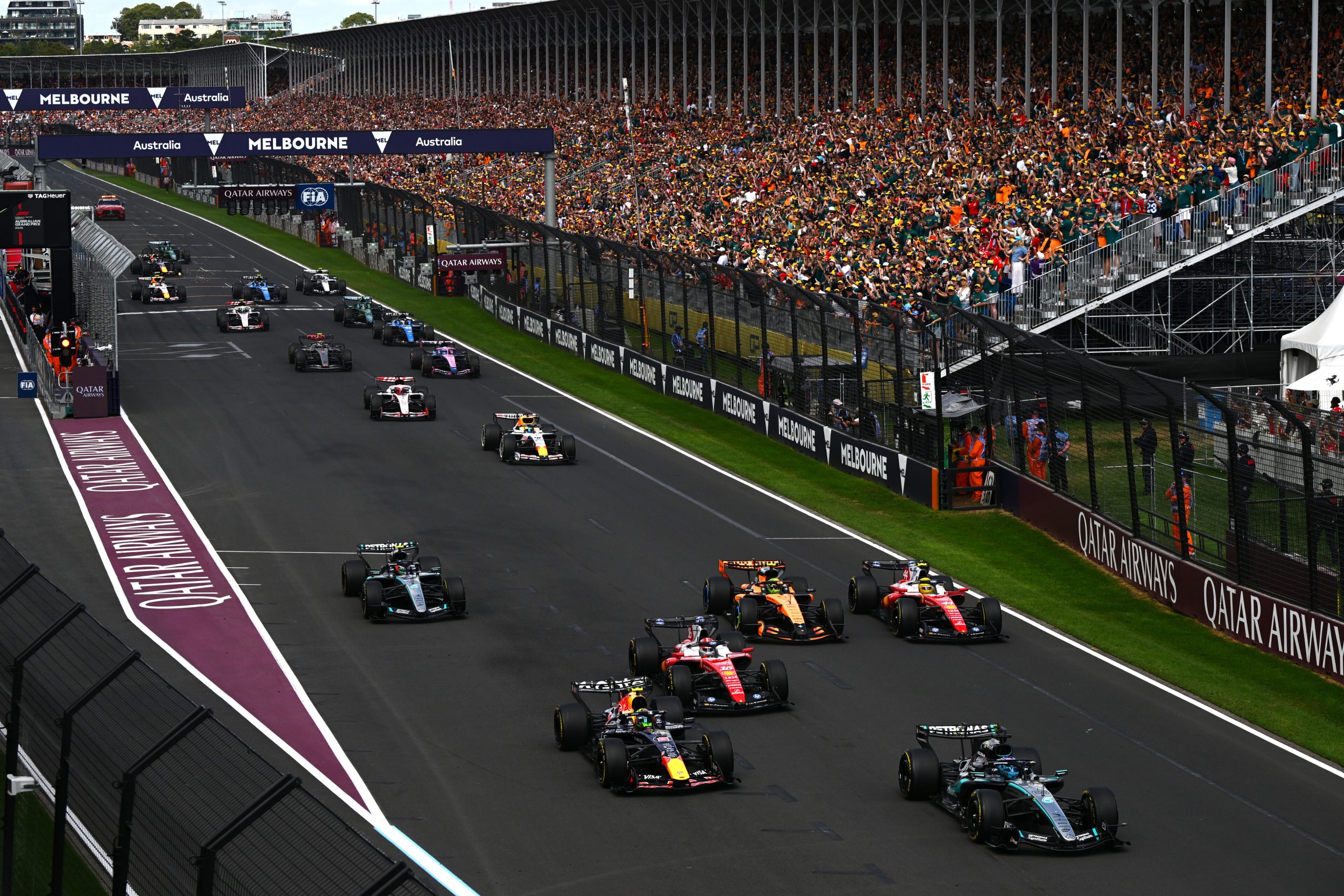
The opening race of the 2026 F1 season in Melbourne at the Australian Grand Prix may have passed without a major accident – but according to Sergio Perez, the sport’s sweeping new regulations have introduced a dangerous variable at the very moment when the field is most vulnerable: the race start.
And after a heart-stopping near-miss between Liam Lawson and Franco Colapinto at the Australian Grand Prix, the Cadillac driver fears Formula 1 may be on borrowed time before a serious crash erupts.
The source of the dread lies within the complex heart of the 2026 power units. With the removal of the MGU-H and a massive shift toward electrical dependency, the art of the "start" has become a mechanical minefield.
Drivers must now hold their engines at high revs for ten agonizing seconds to spool the turbo – a delicate balancing act where a single millisecond of mistiming can trigger anti-stall, leaving a car motionless while a pack of machines thunders toward it.
A Hidden Hazard at Lights Out
In Melbourne, Lawson became the first victim of this digital glitch. As his Racing Bulls sat paralyzed without battery power when the lights went out, Colapinto’s Alpine was already a blur of acceleration.
The Argentine launched cleanly only to suddenly find a nearly stationary car appearing through the pack ahead.
The Argentine driver reacted instantly, darting away from the back of the slow-moving machine and avoiding what could have been a massive collision at well over 200 km/h.
"When I started to see the onboards after the race, it was even closer than what I thought, even more sketchy," Colapinto admitted.
"Generally it's things that we were expecting that would happen and things that we knew that were there and issues that everyone was getting, every team."
Franco Colapinto’s maneuver around Liam Lawson at the start was INCREDIBLE. pic.twitter.com/ole7MCjjoe
— Motorsport (@Motorsport) March 8, 2026
For Perez, the incident wasn't just a lucky escape – it was a warning. The veteran Mexican driver believes the current regulations have created a delta of speed that the human eye – and the carbon-fiber chassis – cannot safely manage.
“It's a shame,” Perez warned. “It's a shame that I say, but it's just a matter of time before a massive shunt happens."
Perez highlighted the terrifying physics at play. When the 2026 boost kicks in, the acceleration is violent. If a car ahead is harvesting energy or trapped in anti-stall, the closing speeds are reminiscent of a highway vehicle encountering a brick wall.
"You can get anti-stalled, like what happened to Lawson, and then that can be very, very dangerous, because the speeds that you end up doing within two to three seconds are extremes," he added.
"So it's a difficult one, because I don't know what you can do in that regard. It's just these new engines are very difficult to start.”
Closing Speeds and Lethal Deltas
The danger isn't limited to the standing start. Because the new cars rely so heavily on intermittent electrical "boosts," one driver might be at full pelt while another is "harvesting" energy, creating massive speed discrepancies on the straights.
Colapinto revealed that the Melbourne start was nearly a 200km/h impact.
“We talked in many different situations that these things were going to be a thing to look at and possible dangerous situations. It happened. Luckily I could manage to escape from it and manage to do the whole race,” he said.
©Red Bull
However, the Alpine driver noted that the danger is omnipresent during every session.
“I was already doing 200 something km,” Colapinto added. “So we were already very quick. When this boost kicks in and then the energy, it is a lot of power and we come very quick.
Read also:
“There is a big speed difference between the cars that are having a problem and the cars that are going normally. I had, also, FP2 I think it was, I had a close call with Lewis [Hamilton].
“On the main straight I was going really slowly and these speed differences are happening all the time.”
As Formula 1 heads deeper into the new era, the spectacle of faster and more powerful machines may thrill fans.
But after Melbourne’s near-miss, some drivers are already bracing for the moment when luck runs out – and Pérez fears that when it does, the impact could be enormous.
Keep up to date with all the F1 news via X and Facebook