

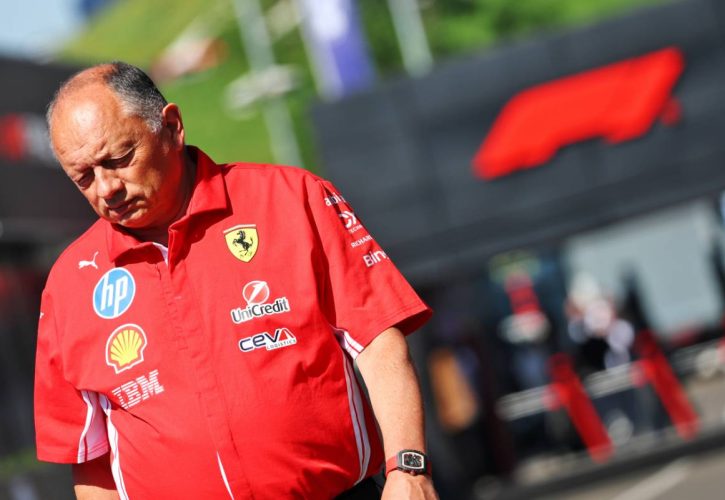


Ferrari team principal Fred Vasseur has questioned the FIA’s decision-making after Max Verstappen’s qualifying crash at the Austrian Grand Prix, admitting he was surprised race control did not immediately introduce double yellow flags at the Red Bull Ring.
The controversy erupted in the final moments of Q3 when Verstappen lost control of his Red Bull at Turn 9 and ended his session in the barriers.
Despite the incident, Mercedes driver George Russell continued his final flying lap under single yellow conditions and went on to secure pole position.
Ferrari had reason to wonder what might have been. Charles Leclerc and Lewis Hamilton had already completed their final attempts before the crash, finishing first and second, but the absence of double yellows allowed Russell to continue his lap and deny Ferrari a front-row lockout.
Vasseur questions the message sent by race control
Vasseur made clear that he was not criticising Russell’s achievement, but he questioned whether the FIA’s response created the wrong incentives for future qualifying sessions.
“First, I'm a bit surprised that they didn't put double yellow,” he told Sky Germany. “When you deploy the medical car, you can imagine that you need to have the double yellow… but it's another story.
“And George did a fantastic lap and nothing to do with the performance of George. And then there is a rule that you have to slow down by 5% in the mini sector and we don't have access to the data. I think that race control did it.”
George Russell explains how his final lap of Qualifying unfolded with the single yellow flag at Turn 9 🗣️#F1 #AustrianGP pic.twitter.com/HwsLbpblSF
— Formula 1 (@F1) June 27, 2026
Under the current regulations, drivers can keep lap times set under single yellow flags if they are judged to have slowed sufficiently. Double yellow flags, however, automatically invalidate qualifying laps, making the decision to use them a crucial one.
Trusting the FIA, but warning of consequences
Despite his concerns, Vasseur stressed that he accepted the stewards’ verdict and believed Russell had complied with the rules.
“I trust them. If you are not able to trust the race control, it's a disaster,” he said.
“If they took the decision of no further action, it's because they checked. The point is for me that I don't understand why we don't have a double yellow in this case.”
For the Frenchman, the issue was not what Russell did, but what message the incident sends to the rest of the grid. If drivers believe they can continue pushing after a crash without triggering automatic lap deletion, the incentive to lift could disappear.
“I think the negative side of this is that next quali, if you have a crash, everybody will push,” he said.
The debate revives a long-running Formula 1 discussion over yellow flag enforcement.
Automatic lap deletions for double yellow infringements were introduced after a series of controversial incidents, designed to remove uncertainty and ensure drivers immediately back off when safety conditions worsen.
In Austria, the FIA judged Russell had done enough under single yellows. But Ferrari’s concern is that the narrow line between compliance and risk-taking could become even harder to manage in future qualifying battles.
Keep up to date with all the F1 news via X and Facebook