



It’s the most iconic and challenging track in Grand Prix racing, with as many pitfalls as it has corners, one of which is the slowest in F1. But there's one thing justifiably missing from Monaco's layout: a long straight.
As a high-downforce venue, the Principality’s legendary street circuit puts very little premium on top speed.
However, the 'Nouvelle Chicane' is arguably the only spot where a driver is offered a reasonable opportunity of overtaking a rival. So, a car's velocity through the tunnel is relatively – and we stress relatively – important to pull off the always bold feat.
Looking at Saturday’s numbers from qualifying, the speed delta between the fastest and slowest performers in the field was a mere 8 km/h, precisely because everyone runs their car in a high downforce configuration to maximize grip and stability through the circuit's tight and twisty corners.
Interestingly however, while looking at the speed trap numbers captured at the exit of Monaco’s tunnel, and taking into account the FIA’s ban this weekend on active aero, the data provides us with an approximate snapshot of the field’s pecking order in terms of drag.
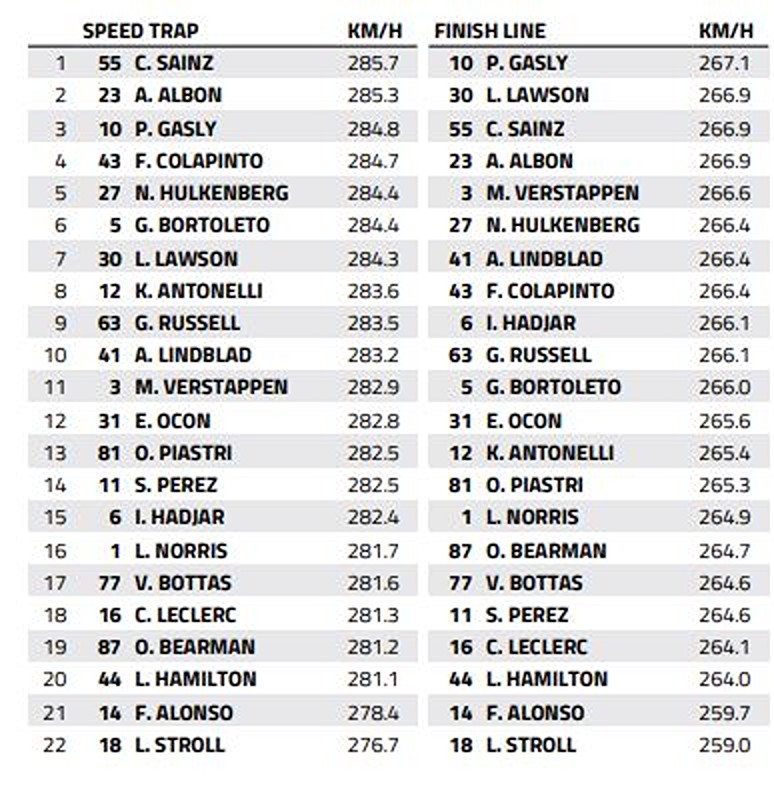
Williams’ FW48 comes out on top, just ahead of Alpine’s A526, while Ferrari’s “draggy” car sits at the other end of the spectrum, as expected. Mercedes and Red Bull fall more or less in the middle of the pack with their optimal compromise, hence their speed in qualifying.
On the strategy front, as usual, track position in Monaco is paramount.
That puts immediate focus on the launch, where the soft tyre – offering maximum grip off the line – is expected to be the preferred choice for those chasing early gains.
After that first rush, strategy settles into a long, tense calculation. Tyre degradation is extremely low, so a one-stop race is the clear baseline, with all three compounds realistically in play.
The quickest tyre strategy... in theory
Pirelli’s modelling points to a Soft-Medium plan as the quickest route, with the optimal pit window between Laps 31 and 37.
Still, Monaco rarely obeys predictions. Safety Cars, Virtual Safety Cars, or an opportunistic undercut could all redraw the plan in seconds, forcing teams to adapt on instinct rather than schedule.
“In the case of a clean race, we clearly expect a one-stop with a soft and medium,” says Dario Marrafuschi, Pirelli’s head of motorsport.
“The second option, slower by a few seconds would be soft>hard and the third option medium>hard… though medium>hard in a standard race is not really the best choice.”
The final unknown sits above the circuit. While Monaco has flirted with passing clouds at points this weekend, the overall outlook remains calm.
Only a small chance of rain lingers at around five per cent, leaving teams to prepare primarily for a dry, tactical chess match through the streets of Monte Carlo.
As stated above, everything hinges on the start. Can Kimi Antonelli avoid another sluggish launch? Or can Ferrari – and especially Lewis Hamilton – out-drag everyone into Ste Devote?
Wait and see…
Keep up to date with all the F1 news via X and Facebook