




Jessica Hawkins has heard the argument before: Formula 1 is simply too physically demanding for women. And the Aston Martin ambassador has little patience for it.
Having experienced the brutal reality of an F1 car herself, Hawkins insists there is no biological roadblock standing between a talented female racer and the world championship.
In fact, the former W Series driver believes it is only a matter of time before a woman finally breaks through onto the F1 grid – potentially within the next few years.
Her prediction comes as the sport continues pouring resources into developing female talent through F1 Academy, a series Hawkins believes could finally provide the missing link between karting success and genuine opportunities at the highest level.
‘I am absolutely convinced women are strong enough’
Hawkins knows exactly what an F1 car can do to the human body. In 2023, she became the first woman in almost five years to test a modern F1 machine when Aston Martin handed her the AMR21 at the Hungaroring.
She completed roughly half a race distance and felt the strain in her neck. But Hawkins rejects the idea that the experience demonstrated a fundamental physical disadvantage.
“I am absolutely convinced women are strong enough for Formula 1,” she said, speaking on the Road to Success podcast. “I'm convinced, having driven one myself for half a race distance, I could have done a whole race distance.
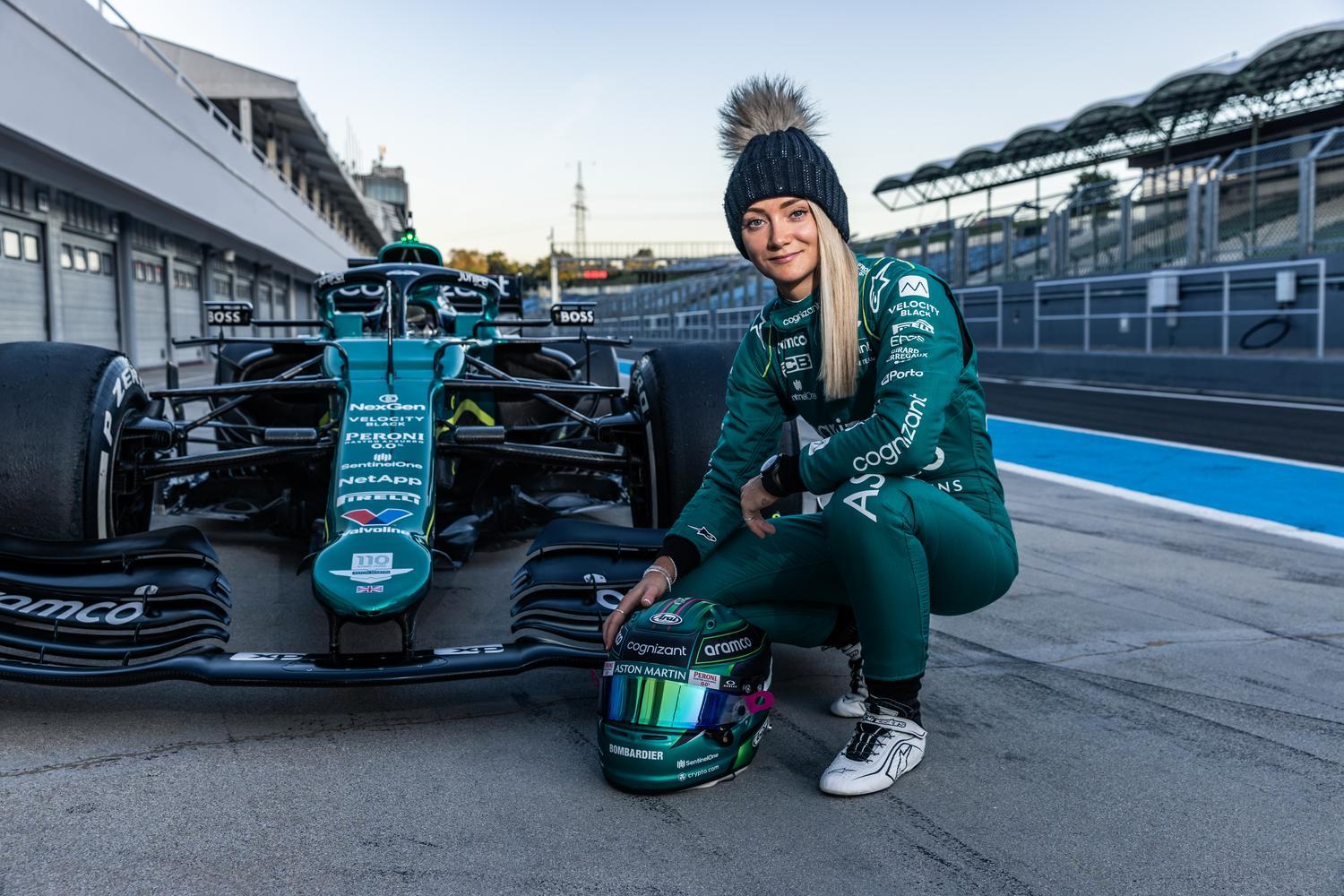
©Aston Martin
“My neck was struggling. My neck was really struggling. But I think every single person's first time in a Formula 1 car, their neck struggled. That wasn't because I was a female.
“That was also because I hadn't been racing in a Formula 2 championship leading up to it. I hadn't been racing in a Formula 3 championship right before it.
“Even the Formula 1 drivers, their first time back in a year, their neck is probably sore at the end of the day. That wasn't because I was a female. I could have done a race distance if it wasn't for my neck.”
It is a pointed rebuttal to one of the sport's longest-running objections. For Hawkins, the question should not be whether women can physically withstand F1, but whether they are being given enough opportunities to develop the skills and experience necessary to earn a seat.
And she expects that equation to change.
Can F1 Academy change the game?
Hawkins was unequivocal when asked whether she expects to see a woman race in F1 during her lifetime.
“I think we're a few years away from it. But I do believe it will happen,” she explained.
“I would be a fraud if I sat here and said I didn't think that would happen because I do believe it. If I were to say no, it would go against everything I stand for.”

The Briton sees F1 Academy as potentially transformative because young female drivers now have a competitive pathway that simply did not exist when she was starting out.
“It is different now because if you look at F1 Academy, wow, I could have only dreamt of that at my age,” she said. “And some of them probably don't realise what it was like even just a few years ago. I think the championship has the ability to really make some drivers.
“Some drivers will go into it, and they'll sink. Some drivers will go into it, and they'll swim. And the ones that swim, they're the ones that are good enough to go up and fight for these Formula 1 seats and fight for opportunities within motorsport.”
That last distinction is crucial. Hawkins is not suggesting F1 Academy should guarantee a woman a place on the F1 grid. Instead, she believes it can finally create the conditions in which female drivers can prove they deserve one.
For a sport that has waited decades for its next female Grand Prix driver, Hawkins' message is therefore both optimistic and provocative: the physical excuse is running out of road.
Keep up to date with all the F1 news via X and Facebook